



2025-07-15
Zhuzhou Century Tool, a specialized manufacturer of tungsten carbide cutting tools, today announced the completion of a dedicated R&D program for aluminum machining: a new family of insert grades engineered specifically for aluminum and non-ferrous alloys, paired with a redesigned chip-breaker geometry platform developed through simulation-driven iteration and field validation.
The program targets a problem that has long frustrated production engineers: aluminum is one of the easiest materials to cut, and one of the hardest to cut well. Low cutting forces mask a chain of failures that begins at the cutting edge — adhesion, built-up edge, and chip entanglement — and ends with a scrapped part and a stalled line.
Why Aluminum Demands a Different Tool
The chemistry of aluminum machining works against conventional insert design:
Adhesion and built-up edge.
Aluminum welds to the cutting edge at machining temperatures. Material builds up, changes the effective geometry, and periodically breaks away — taking edge material with it and leaving a degraded surface finish.
Long, stringy chips.
Ductile aluminum produces continuous chips that wrap around the tool and workpiece, scratch finished surfaces, and force operators to stop the machine.
Abrasive silicon particles.
In high-silicon alloys (A356, A380, and hypereutectic grades above 12% Si), hard primary silicon crystals act like an abrasive compound, wearing edges far faster than the bulk hardness of the alloy would suggest.
A steel-oriented insert carries a compromise into this environment: coatings and edge preparation tuned for steel behave differently on aluminum, where a mirror-polished surface and a sharp, controlled edge matter more than oxidation resistance.
The Grade: Substrate and Surface Engineering
The new aluminum grade family starts from the substrate and works outward:
Sub-micron grain tungsten carbide.
The fine grain structure delivers the hardness needed to resist abrasive wear from silicon particles while preserving sufficient toughness for edge integrity across interrupted cuts.
Binder tuning per variant.
Cobalt content is adjusted per grade — a tougher, higher-binder variant for roughing and interrupted cutting; a harder, wear-focused variant for finishing and high-speed continuous passes. The balance is engineered per application, not per cost target.
Mirror-polished rake face.
Rake-face roughness is held to a fraction of a micron. Polishing removes the microscopic nucleation sites where aluminum begins to weld, starving built-up edge before it can form. The difference is measurable not just in tool life, but in surface finish consistency across the batch.
Edge preparation without compromise.
Honing is minimized and uniformly controlled: sharp enough to cut cleanly through soft aluminum without smearing, robust enough to avoid micro-chipping at entry. For high-silicon alloys above 12% Si, PCD-tipped and CVD diamond-coated variants extend the same philosophy — diamond's hardness and thermal conductivity carry the abrasive load that would quickly blunt carbide.
The Chip Breaker: A Design Philosophy, Not a Groove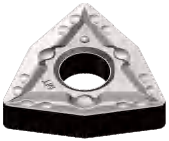
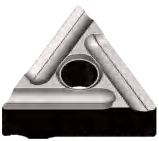
The second half of the program was the redesign of the chip-breaker platform. The design philosophy rests on three commitments:
Finishing grooves
with lighter chip control and a sharper edge, optimized for surface finish on the last pass;
Roughing grooves
with stronger deflection, engineered to manage heavy depths of cut and higher feed rates without letting chips pile up;
Turning-specific and milling-specific profiles
each matched to how the chip flows in that process.
What This Means on the Shop Floor
The combined effect of the new grades and geometry platform translates into outcomes production engineers can measure:
Consistent surface finish
— reduced built-up edge means fewer scratch marks and rework loops on aluminum components;
Longer, predictable tool life
— the edge wears, rather than breaking or welding away;
Higher cutting parameters
where the setup permits, and fewer interruptions from chip wrapping;
Cleaner automation
— predictable chip forms keep swarf out of the work zone, protecting both the part and the machine.
Availability
The new aluminum-specific grades and chip-breaker geometries are available across standard ISO turning and milling insert styles, in the size range, with both polished uncoated and diamond-coated options. Sample inserts are available for customer testing; our applications team supports grade and geometry selection based on alloy, machine, and operation.
Zhuzhou Century Tool is a specialized manufacturer of tungsten carbide cutting tools serving machining professionals worldwide. From standard ISO geometries to application-specific profiles, the company combines advanced pressing and sintering technology with rigorous quality control — dimensional inspection, microstructure analysis, and cutting-performance testing on every batch.
For inquiries or sample requests, contact info@zzcarbidetool.com / visit https://zzcarbidetool.com


