The first step is to identify the thread standard required for the workpiece.
| Thread Standard | Typical Application | Recommended Insert |
|---|---|---|
| ISO Metric | General mechanical components | 60° Metric Threading Inserts |
| UN / UNF / UNC | North American machinery and fasteners | 60° UN Threading Inserts |
| NPT | Pipe fittings, oil & gas, fluid systems | 60° NPT Threading Inserts |
| Whitworth / BSP | Pipe connections and British-standard applications | 55° Whitworth Threading Inserts |
| ACME / Trapezoidal | Power transmission and lead screws | Trapezoidal Threading Inserts |
| Custom Threads | Special components and non-standard applications | Custom Threading Inserts |
Tip: Always confirm the thread standard before selecting the insert. A 60° metric insert, for example, should not be used to produce a 55° Whitworth thread.
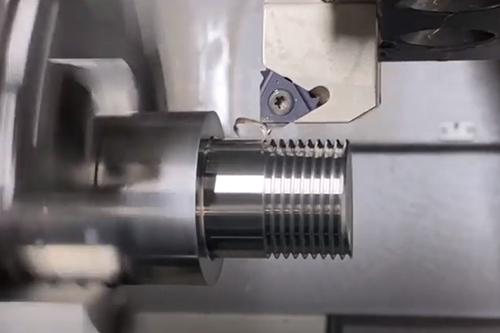
Thread profile determines the included angle and cutting geometry of the insert.
Commonly used for:
ISO Metric threads
UN threads
NPT threads
Other 60° thread profiles
Commonly used for:
Whitworth threads
BSP pipe threads
British-standard thread applications
Using an insert with the wrong profile angle can result in incorrect thread geometry, poor fit, and dimensional problems.
One of the most important decisions is whether to use a full profile threading insert or a partial profile threading insert.
| Feature | Full Profile Insert | Partial Profile Insert |
|---|---|---|
| Thread crest | Forms the complete crest | Does not fully form the crest |
| Pitch | Designed for a specific pitch | Can cover multiple pitches |
| Thread accuracy | Excellent | Good |
| Production efficiency | High for mass production | Flexible for different threads |
| Tool inventory | More inserts required | Fewer inserts required |
| Best application | High-volume production | Small batches / multiple pitches |
Full profile inserts form the complete thread profile, including the thread crest.
They are recommended for high-volume CNC production where the same thread specification is repeatedly machined.
Advantages include:
Consistent thread geometry
Accurate thread crest formation
Reduced secondary finishing
Good repeatability
High production efficiency
Partial profile inserts form the thread flanks but do not completely form the thread crest.
They are particularly useful when machining different thread pitches with the same insert.
They are a good choice for:
Small-batch production
Job shops
Prototyping
Multiple thread pitches
General-purpose CNC threading
Thread pitch has a direct influence on insert geometry and cutting conditions.
For example:
Fine-pitch threads require appropriate fine-pitch insert geometry.
Coarse-pitch threads require sufficient insert strength and suitable cutting depth.
Large-pitch threads may require multiple cutting passes and stable tool holding.
When selecting an insert, confirm:
Thread standard + pitch + internal/external thread + insert size
For example:
M20 × 2.5 external thread → 60° ISO Metric Full Profile Threading Insert for 2.5 mm pitch.
Different materials require different carbide grades, coatings, and chip-control geometries.
| Workpiece Material | Recommended Insert Characteristics |
|---|---|
| Carbon Steel | Balanced wear resistance and toughness |
| Alloy Steel | High wear resistance and edge strength |
| Stainless Steel | Sharp cutting edge and anti-built-up-edge geometry |
| Cast Iron | Good abrasion resistance |
| Aluminum | Sharp edge and polished cutting geometry |
| Hardened Steel | Wear-resistant carbide grade and suitable coating |
| Titanium Alloys | Tough substrate and heat-resistant coating |
| Nickel-Based Alloys | High-temperature resistance and stable edge geometry |
For difficult-to-machine materials, insert selection should be combined with optimized cutting speed, feed rate, depth of cut, and coolant conditions.
The insert geometry and holder must match the machining method.
External threading is used to produce threads on the outside diameter of shafts, bolts, pipes, and other cylindrical components.
Common insert designations include:
16ER, 22ER, 27ER
Internal threading is used to machine threads inside holes, sleeves, nuts, and pipe fittings.
Common insert designations include:
16IR, 22IR, 27IR
The insert must be correctly matched with the corresponding threading tool holder.
Threading inserts are available in different hand orientations.
Common configurations include:
Right-hand threading
Left-hand threading
External threading
Internal threading
Before ordering, confirm the required thread direction and tool holder configuration.
Incorrect selection can prevent the tool from producing the required thread correctly.
Carbide grade is another important factor affecting tool life and machining stability.
A general selection principle is:
Tougher grades → interrupted cutting / unstable conditions
Harder, more wear-resistant grades → continuous cutting / high-speed machining
The appropriate grade depends on:
Workpiece hardness
Cutting speed
Machine rigidity
Cutting depth
Coolant conditions
Continuous or interrupted cutting
Required tool life
For difficult applications, a customized carbide grade and coating can provide better performance than using a general-purpose insert.
Coating technology can significantly improve the wear resistance and thermal stability of carbide threading inserts.
Common coating technologies include:
TiN
TiCN
TiAlN
AlTiN
Multilayer PVD coatings
The coating should be selected together with the carbide substrate and workpiece material.
For example, applications involving hardened steel or alloy steel may benefit from a wear-resistant coating, while stainless steel threading may require a coating and cutting geometry designed to reduce built-up edge.
The best insert is not always the one with the lowest unit price.
For small-batch production, a partial profile insert may reduce the number of different inserts required.
For high-volume production, a full profile or multi-tooth threading insert can improve productivity and reduce machining time.
Small Batch → Partial Profile Insert
General CNC Production → Full / Partial Profile Insert
Mass Production → Full Profile / Multi-Tooth Insert
When selecting a threading insert, check the following six parameters:
1. Thread Standard
Metric / UN / NPT / Whitworth / ACME / Custom
2. Thread Angle
60° / 55° / other special profiles
3. Thread Pitch
Fine / medium / coarse
4. Thread Type
Internal / External
5. Workpiece Material
Steel / Stainless Steel / Cast Iron / Aluminum / Hardened Steel / Exotic Alloys
6. Production Requirement
Small batch / General production / High-volume production
Correct Threading Insert = Thread Standard + Profile Angle + Pitch + Internal/External + Workpiece Material + Machining Requirement
Choosing the insert based on these factors helps achieve stable thread dimensions, good surface finish, longer tool life, and reliable CNC machining performance.
If you are not sure which carbide threading insert is suitable for your application, provide the following information:
Workpiece material
Material hardness
Thread standard
Thread size
Thread pitch
Internal or external thread
CNC machine type
Current cutting speed and feed
Production volume
Based on these parameters, the appropriate carbide grade, coating, insert geometry, and threading insert specification can be selected for your application. Or you can simply contact info@zzcarbidetool.com for help.